
WOMEN WHO
MADE PIZZA HISTORY
Featured at the Las Vegas Pizza Tailgate
CELEBRATING WOMEN’S HISTORY MONTH
An introduction to four women who altered the course of pizza history
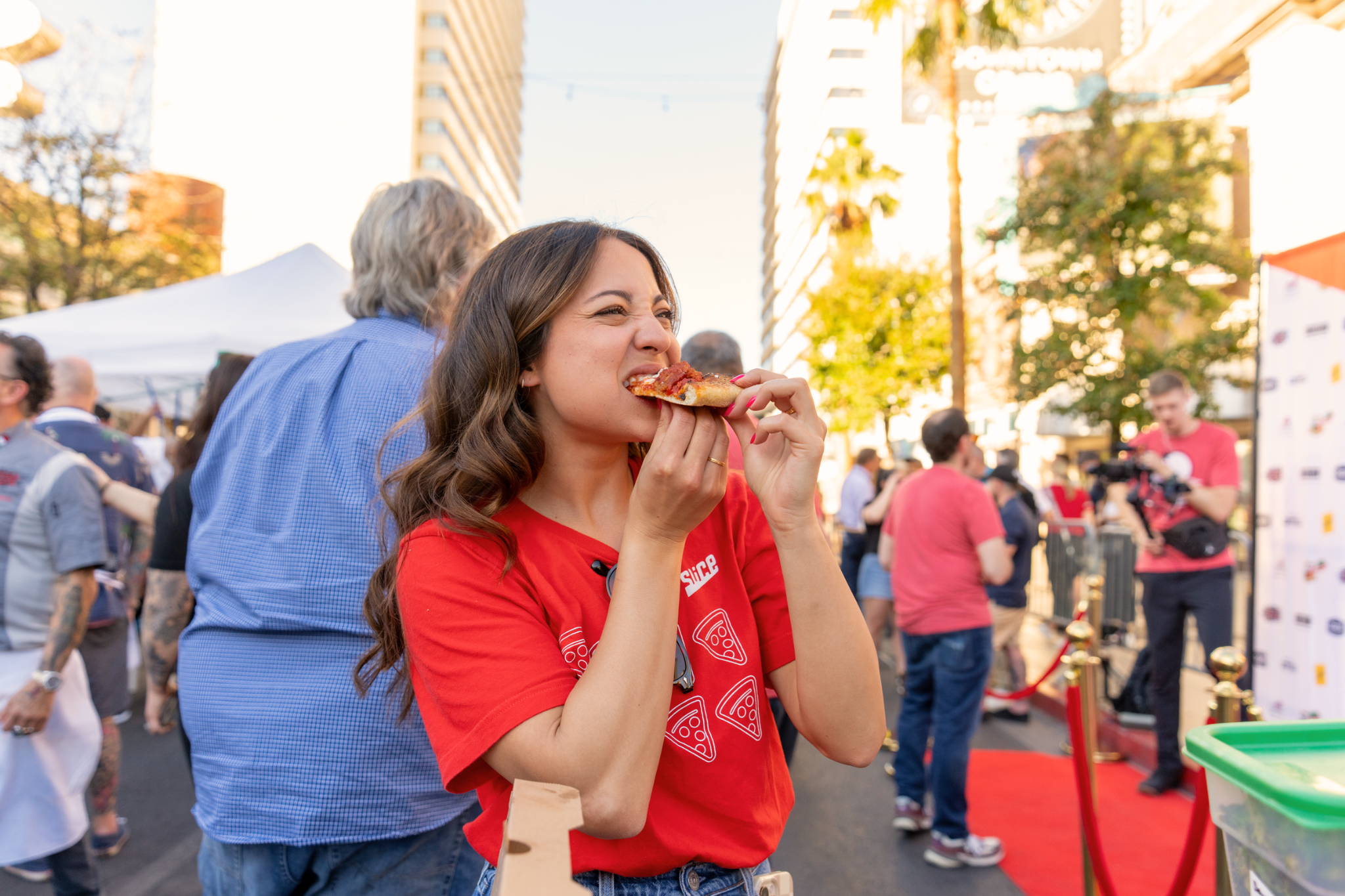
This year at the LV Pizza Tailgate at International Pizza Expo, Slice Out Hunger is honoring four women who made pizza history. Each of our four pizza stations will be named for one of the four women whose accomplishments are highlighted below and all of the pizza makers at the event will be collaborating on specialty pies that pay homage to the women at their respective stations.
Their life and accomplishments are described below, but we’d be remiss if we didn’t mention that the historical records are far less complete for these women than they are for their male contemporaries. Countless other women aren’t documented at all in spite of their contributions due to a long history of undervaluing the labor of women, queer-identifying individuals, and people of color. Slice Out Hunger applauds the work that initiatives like For the Love of Pizza, Fork to Future, Latinos en Pizza, and Women in Pizza are doing to recognize the accomplishments of historically underrepresented groups and make sure that the future of pizza is bright by helping more people hone their pizza craft.
MARIA GIOVANNA BRANDI
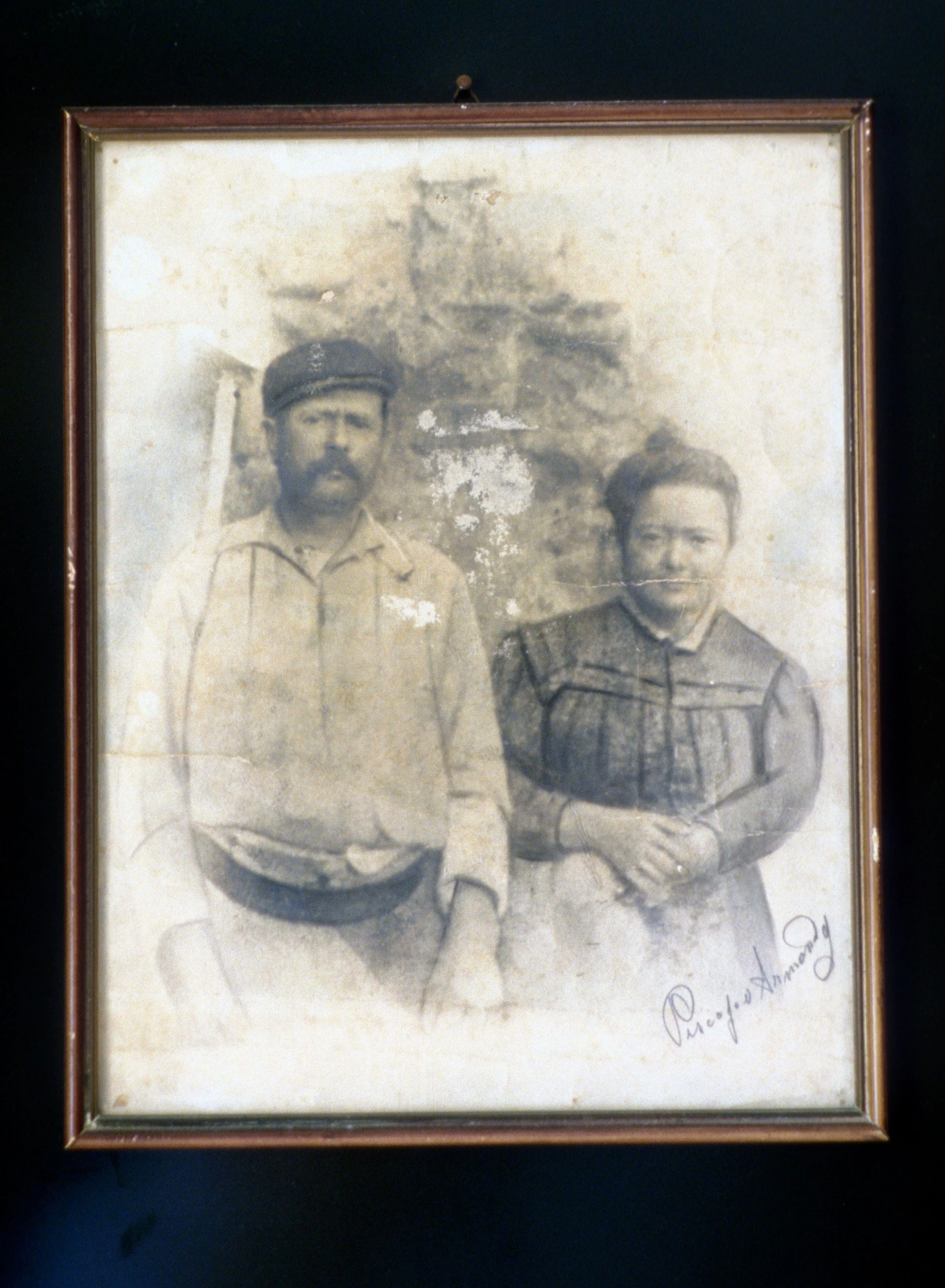
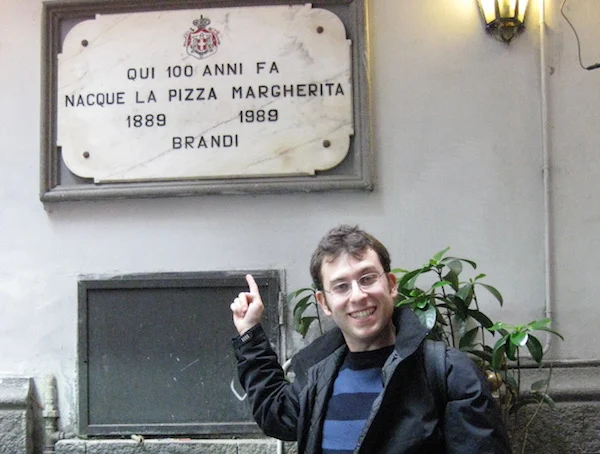
While historical accounts differ on whether or not Maria Giovanna Brandi and her husband Raffaele Esposito created the now iconic classic Neapolitan pizza using mozzarella, crushed tomato, and basil there is no denying that their marketing ploy of naming the Pizza Margherita after Margherita of Savoy, Queen consort of Italy, forever changed the course of pizza history.
The legend behind the Pizza Margherita credits Esposito for the invention of (as opposed to just popularization of) what is now known as a Pizza Margherita. When Esposito presented the pizza destined for the Queen to his wife Maria Giovanna she allegedly added fresh basil as a flourish so the pie matched the green, white, and red of the Italian flag. When Queen Margherita arrived in Naples in May of 1889 for the inauguration of the Risanamento construction, she declared this pie her favorite of the three Esposito presented her with and it was thus christened “Margherita.”
Pizza had been around in Naples for over 100 years at this point and they were by no means the first to use tomatoes, basil, and mozzarella on a pie. In fact, Maria Giovanna was the daughter of Luigia Ottaiani, a pizzaiola and shop owner. Maria Giovanna likely grew up learning the art of pizza making from her mother. There’s no record that Esposito had experience as a pizzaiolo before acquiring a license for an existing pizzeria, the Pizzeria di Pietro (still operating today under the name Pizzeria Brandi), in 1877, the same year that he married Brandi so it’s likely that she had a considerable influence on the development of his pizza trade.
Although the letter that authenticates the legendary encounter with Queen Margherita was proven a forgery by pizza historian Zachary Nowak, the creation of this legend can be cited as one of the first steps in the journey where pizza transitioned from a an inexpensive street food for the Neapolitan working class to the global phenomenon that it is today. If nothing else, Brandi & Esposito were pioneers in cultivating the modern world’s love affair with pizza.
CRUCIFICIA PASSALACQUA
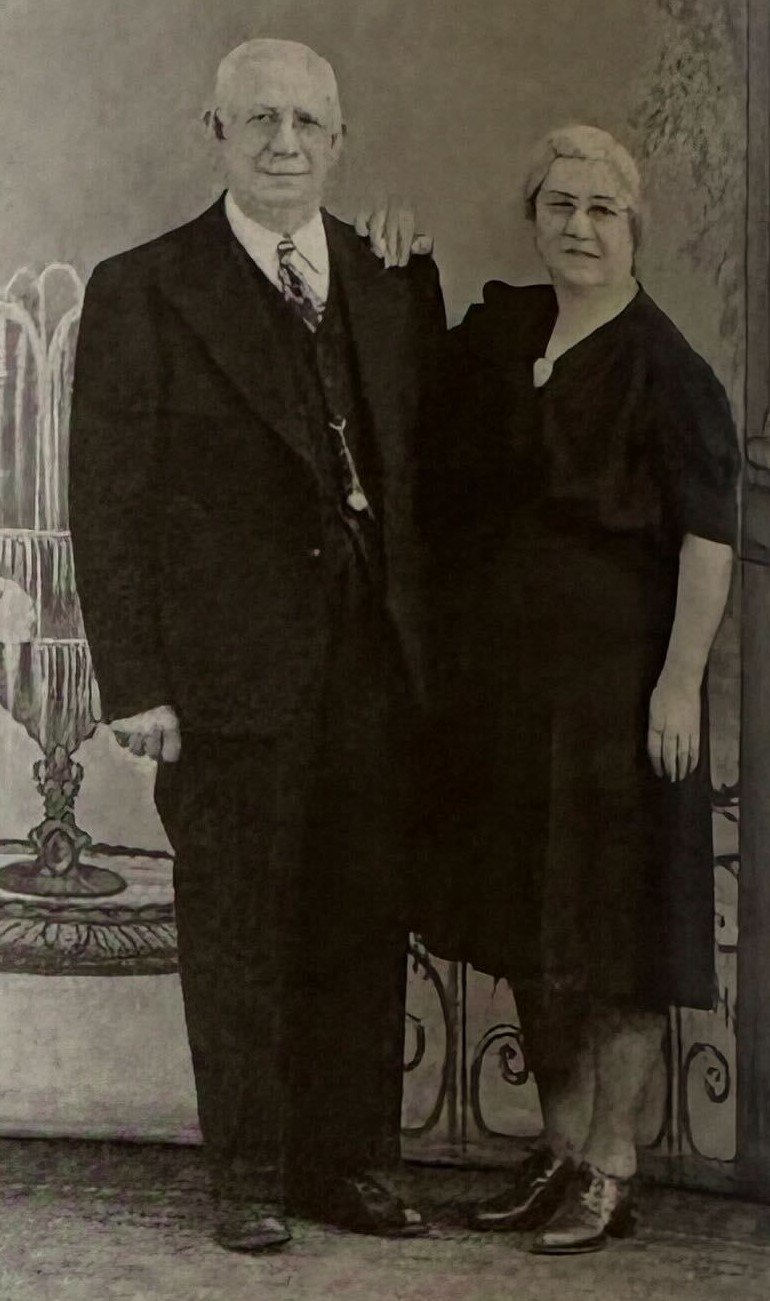
When Gus Guerra married Anna Passalacqua in November of 1940, he had little notion that pizza would be a major part of the trajectory of their life together. For the first four years of their marriage, the young couple was making a home in Detroit and reliant on Gus’s income from his job at the local Ford plant. In 1944, Anna’s uncles Joe and Gasper Genco asked Gus to come in as a partner on their bar, Buddy’s Rendezvous. It’s here, at this beginning, that Crucificia enters the Detroit-style pizza origin story.
Crucificia “Celia” Passalacqua was born around 1880 in Marsala, a town in western Sicily. She immigrated to the US with her three and children in tow sometime between 1908-1911. On the 1930 census, she was listed as an unpaid grocery clerk, likely at the grocery store owned by her half brothers, Joe and Gaspar on Heidelberg St; the same brothers who would later approach Gus with a business opportunity.
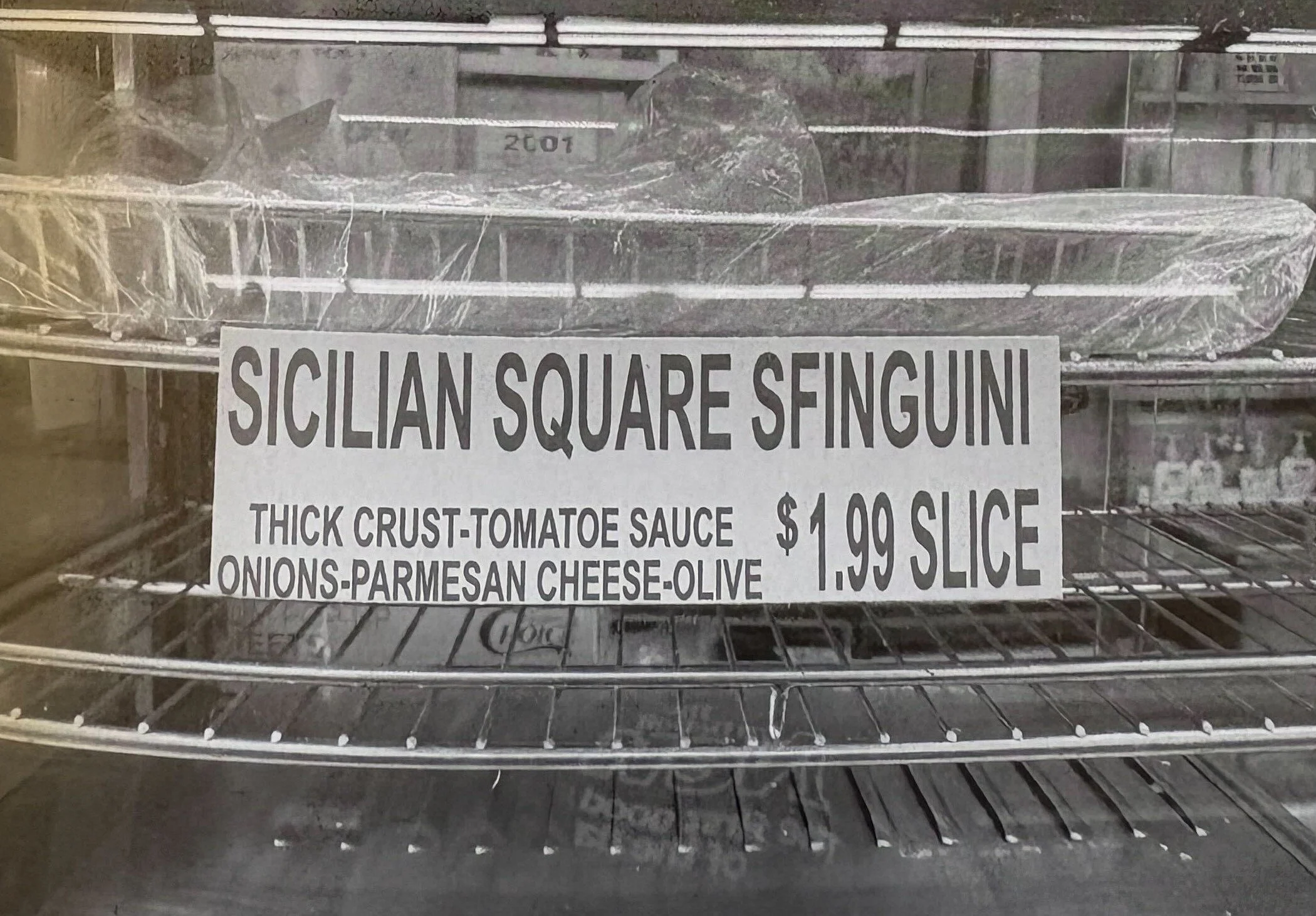
According to pizza historian Peter Regas, Italian bakeries were the progenitors of the pizza shop. Anyone familiar with small bakeries, delis, and grocery stores in cities with historically Italian neighborhoods knows that the line between the three is often blurred, even today. Making pizza in a bakery, deli, or grocery store was commonplace; a good way to feed the family working there and generate a little extra income. The grocery store on Heidelberg St. fit this mold, using the recipe for sfincione that Celia brought with her from Sicily.
To make Buddy’s Rendezvous more profitable, the family brainstormed ideas for bar food that was fast, required little onsite prep, could feed a lot of hungry patrons, and utilized inexpensive locally-made ingredients and steel pans. Gus, Anna, and Celia, experimented with ways to adapt Celia’s sfincione to the American palate. Detroit historian Karen Dybis, speculates that the now iconic red sauce-on-top may have been a concession to Celia as a way to keep the recipe in line with its origins as a sfincione with the added bonus of keeping the crust both light and crunchy.
While Gus sold the original Buddy’s Rendezvous in 1953, Buddy’s still continued to serve the Guerra & Passalaqua recipe. It also continues to live on unaltered in Gus’s second culinary venture, Cloverleaf Pizza, a bar he purchased in East Detroit that same year.
ALICE MAE REDMOND
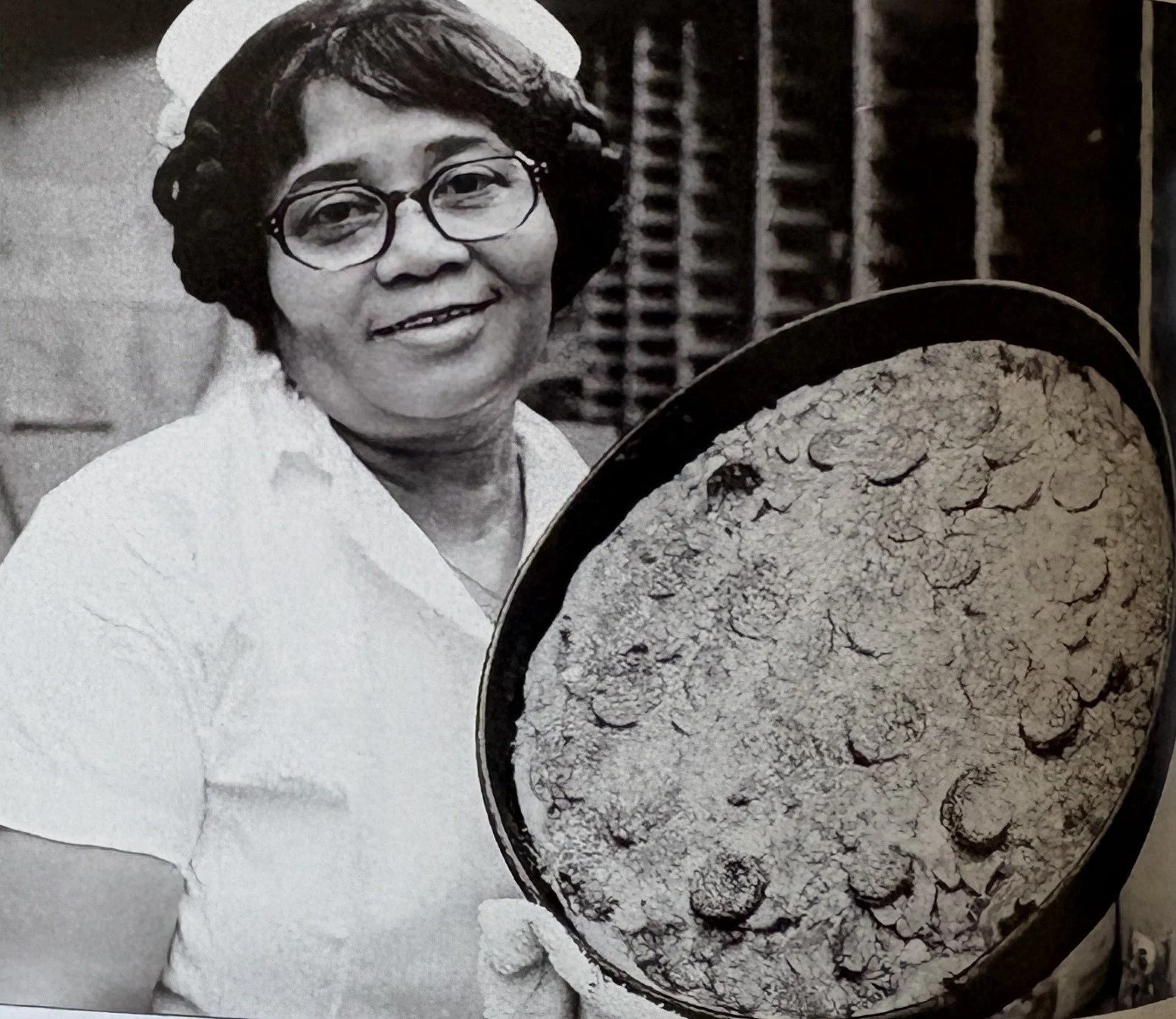
Every quintessential American culinary creation is some variation of old world recipes that are adapted for local tastes and substitutions to replace hard-to-find ingredients, but the story of Chicago deep dish pizza is also one that stems from two distinct culinary lineages; Italian cuisine and African American Southern cuisine. Alice Mae Redmond’s story exists at this intersection.
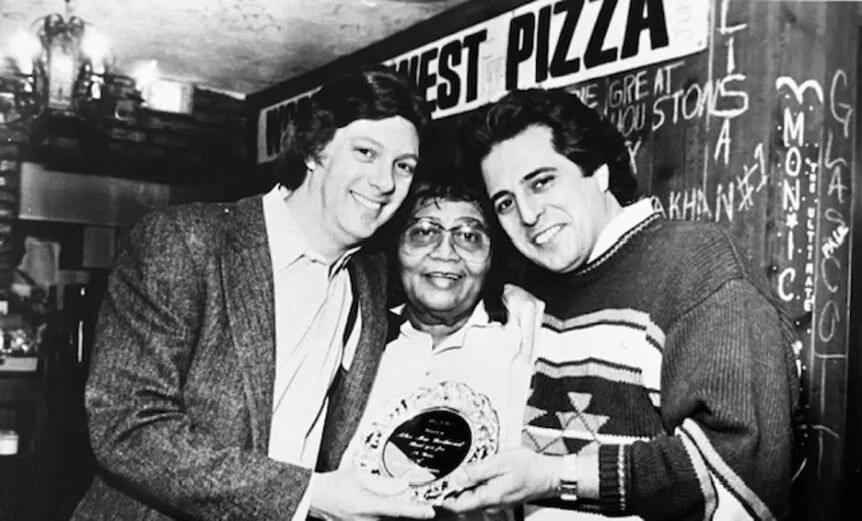
Alice Mae Redmond was born in 1915 in Greenville, MS. She learned to cook from her mother, Sarah Lee Murrell, and was employed as a short order cook in Mississippi during her early career. Like many African Americans of her generation, Alice moved from Greenville to Chicago sometime in the late 1940s as a part of what is now known as the Great Migration. There’s no record of her personal motivation to relocate to Chicago, but the overarching causes for the move northward included racialized violence, Jim Crow Law restrictions, a lack of economic opportunities due to discrimination and sharecropping practices, and the high demand for factory workers in the Rust Belt cities of the North. Upon arriving in Chicago, she put her culinary talents to work at what is now known as Pizzeria Uno in Chicago’s River North neighborhood.
Pizzeria Uno first opened its doors in December of 1943, under the name The Pizzeria which was rebranded as Riccardo’s Pizzeria shortly afterwards before settling in permanently as Pizzeria Uno in 1954. It was not the first pizzeria in Chicago, but the owners, Ric Riccardo and Ike Sewell wanted to serve pizza that was heartier than the Neapolitan and tavern style options that were available in other Little Italy pizzerias. The two worked together to develop a pizza dough that was more akin to a pie crust and capitalize on the ubiquity of steel pans.
Early pizza history stopped there and credited Riccardo and Sewell with the creation of the iconic deep dish, but research by pizza historian Peter Regas in the past few decades has revealed that this story is incomplete:
Regas found photographs from the first 15 years or so of Uno’s existence. He realized that those early pies lack the depth and the ingredients aren’t layered in the reverse order—cheese on the bottom, followed by toppings and sauce…further, none of the early press clippings about the restaurant acknowledged that Pizzeria Riccardo was offering a variation on pizza. (Lifton)
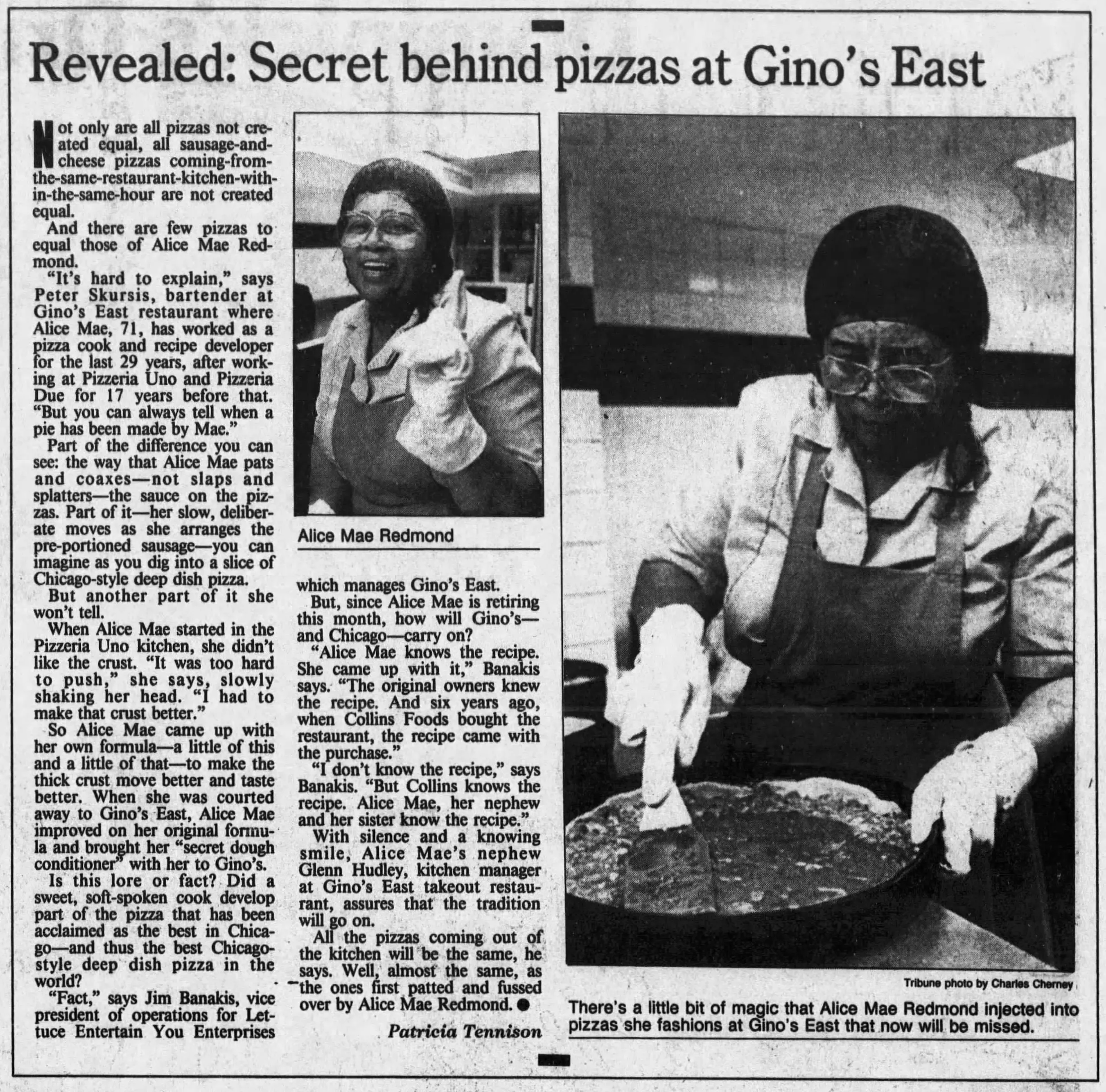
Regas’ 2009 & 2010 interviews with Redmond’s daughter, Lucille Conwell, sheds light on the deep dish’s true origins. According to Conwell, when Redmond started working there, she found Riccardo and Sewell’s dough too stiff to work with. She tapped into her well of knowledge of Southern cooking to create what she called her “secret dough conditioner”. Her new dough had double the fat content of a typical pizza dough, making it easier to knead, and, according to Conwell, incorporated elements of her family’s biscuit recipe.
Around 1960, Redmond was working at Sewell’s new location, Pizzeria Due and picked up additional work at Gino’s East, owned by Sam Levine, Fred Bartoli, and George Loverde. Unhappy with her work for a competitor, Due’s manager Lou Malnati gave Redmond an ultimatum and she decided to work for Gino’s East full-time in 1966 until her retirement in 1989, bringing her daughter Lucille with her. Alice left an undeniable mark on the evolution of Chicago deep dish pizza; her dough recipe is a heavily guarded secret amongst the Chicago deep dish competitors: Pizzeria Uno (known today for their Uno Pizzeria & Grill franchises), Gino’s East, and Lou Malnati’s.
ROSE TOTINO
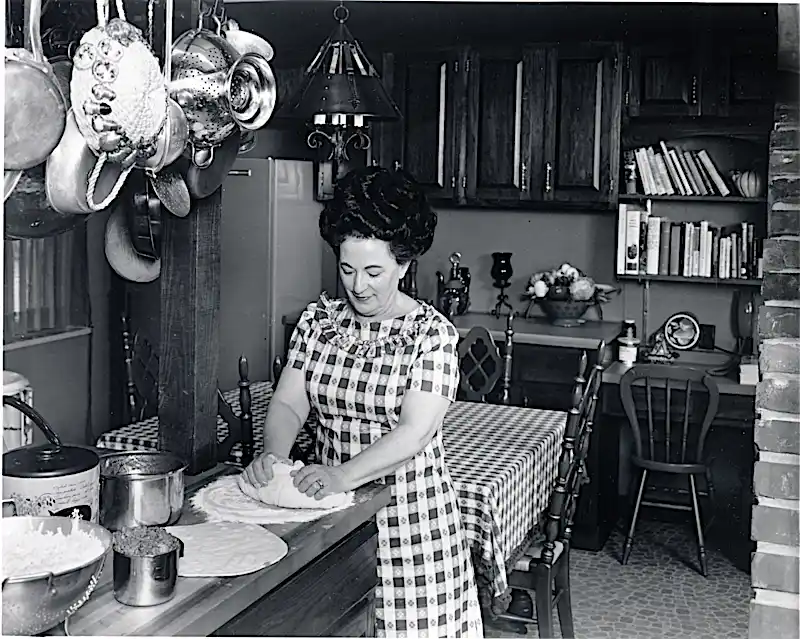
Rose Totino is a rarity amongst her pizzaiola contemporaries in that she achieved recognition for her achievements and commercial success during her lifetime. Born Rosenella Winifred Cruciani in 1915 (the same year as Alice Mae Redmond) to Italian immigrants in Minneapolis, MN, Rose was the third of seven children who grew up eating a small “Italian pie made with sausage, cheese and a variety of sauces,” (Minnesota Inventors). She began working at age 16 after dropping out of school to provide supplemental income for her family by cleaning house until she married Jim Totino at age 19. Jim was a baker by trade and a decade into their marriage, the couple decided to open a restaurant together.
Pizza was hardly the household name that it is today; in the 1940s it was just establishing a foothold in markets like the New York metro area, New Haven, Boston, and Chicago. Rose first encountered a pizzeria as a viable business model on a trip to visit her aunt in Pennsylvania in 1942.
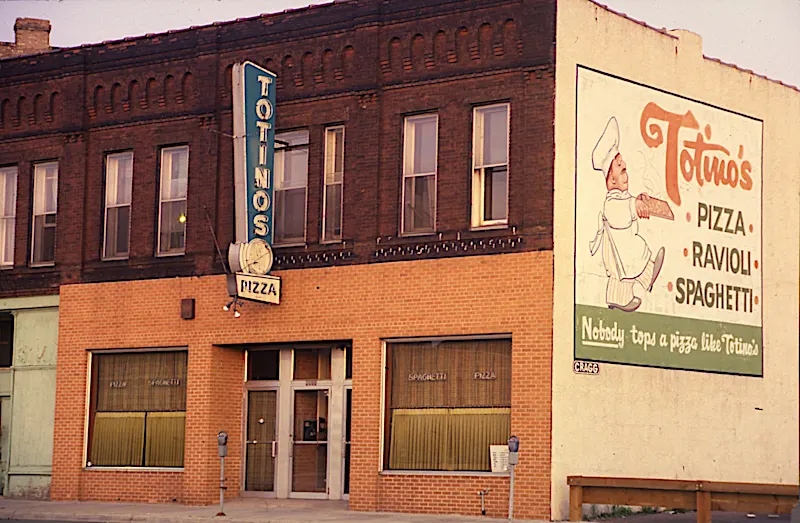
In 1951 when Rose and Jim first opened the doors at Totino’s Italian Kitchen, they never could have dreamed that over the next several decades they would build a frozen pizza empire. In fact, they had a difficult time convincing the bank to loan them the $1,500 they needed for startup cash until Rose baked the banker his first ever pizza. The business started as a small take-out establishment and grew into a sit-down restaurant where Rose and Jim cranked out 500 pies a day as word got out in the Minneapolis community about this delicious new thing called pizza. The couple worked together side-by-side with Jim handling the oven and Rose the rest.
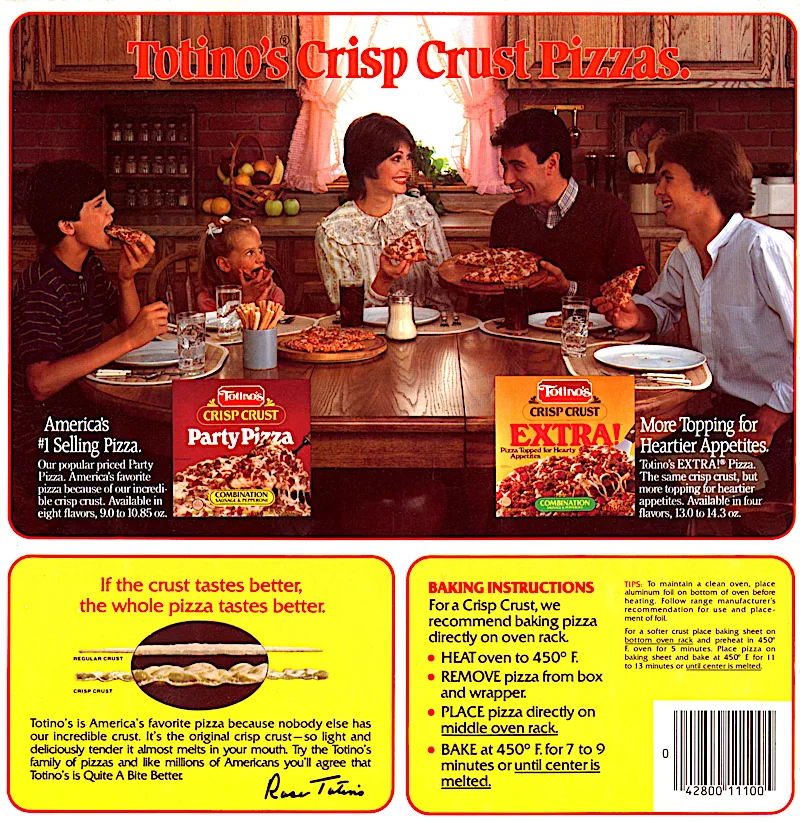
With the booming success of their restaurant, Rose and Jim wanted to give the people more ways to enjoy their food, opening up Totino’s Finer Foods in 1962 so that families could take-and-bake frozen pizzas at the kitchen table. Totino’s was not the first frozen pizza to hit the market (that distinction belongs to) Tree Tavern in 1955, but Rose was the first to patent a pizza dough specifically designed to be frozen in 1979 after years of iteration and refinement.
They first started producing their frozen pizzas in a St. Louis Park factory that they purchased and initially outsourced their crusts frozen from Chicago. Rose was immediately dissatisfied with these crusts and referred to them as “the industry standard cardboard crust,” (Minnesota Inventors). She was determined to design a crust that would crisp after being frozen in a home oven to her satisfaction.
Even after opening a second factory in Fridley, MN in 1971, demand for their frozen pizzas still outpaced their ability to produce them. This combined with concerns about Jim’s health made the couple decide to sell the company to another Minneapolis brand on the rise, Pillsbury. The 1981 sale was for $22 million and was conditional that Rose retain creative control over her pizza recipe. She became Pillsbury’s first female vice president. Still not yet satisfied with the crust and now with a team of elite food scientists at her back, she and the Pillsbury team were the first brand to try frying the pizza crust before freezing to reduce starch retrogradation and help to maintain the structural integrity. This innovation resulted in her 1979 patent.
The fact that the Totino’s pizza brand continues its success to this day is a testament to Rose’s decades-long perseverance in perfecting her crisp crust. Since the discontinuation of the Celentano brothers’ frozen pizza line in 2000, the Totino’s brand, now owned by General Mills since the acquisition of Pillsbury in 2001, is the longest running frozen pizza brand still in production with no signs of slowing down. Between the approximately 10 Totino’s pizza sold each second and America’s ongoing snack affair with their pizza rolls, Rose’s legacy is secure for many years to come.
MARIA GIOVANNA BRANDI
Mattozzi, Antonio. Inventing the Pizzeria. Bloomsbury Publishing, 5 Nov. 2015.
Wiener, Scott. “The Real Story of Pizza Margherita.” Scotts Pizza Tours, 11 June 2020, www.scottspizzatours.com/blog/the-real-story-of-pizza-margherita/. Accessed 19 Mar. 2026.
Photos courtesy of: Alamy, Scott’s Pizza Tours
CRUCIFICIA PASSALACQUA
Dybis, Karen. Detroit Style Pizza: A Doughtown History. Arcadia Publishing, 1 May 2023.
Kirchner, Hallie. “A Genealogy of a Pizza.” Americanancestors.org, 2020, vitabrevis.americanancestors.org/2020/11/genealogy-of-a-pizza. Accessed 19 Mar. 2026.
Photos courtesy of: Guerra family, Karen Dybis
ALICE MAE REDMOND
“Gino’s East.” Gino’s East of Chicago, 12 Feb. 2021, www.ginoseast.com/deep-thoughts/2021/02/12/alice-mae-redmond-a-slice-of-ginos-history. Accessed 19 Mar. 2026.
Lifton, Dave. “A Pizza’s Powerful Origin: Alice Mae Redmond - EAtlas.” EAtlas, Feb. 2023, playeatlas.com/a-pizzas-powerful-origin-alice-mae-redmond/. Accessed 19 Mar. 2026.
“The Real History of Chicago’s Deep-Dish Pizza - EAtlas.” EAtlas, 17 Oct. 2022, playeatlas.com/the-real-history-of-chicagos-deep-dish-pizza/. Accessed 19 Mar. 2026.
Photos courtesy of: Modernist Pizza, Chicago Tribune, Jon Kass News
ROSE TOTINO
“2008 Rose Totino.” Minnesota Inventors Hall of Fame, www.mninventor.org/copy-5-of-2011-richard-thorud. Accessed 19 Mar. 2026.
“FamilySearch.org.” Familysearch.org, 2019, ancestors.familysearch.org/en/GMFL-Q55/rosenella-winifred-cruciani-1915-1994. Accessed 19 Mar. 2026.
Fortey, Ian. “The Oldest Mass-Produced Frozen Pizza Brand You Can Still Find on the Shelves Today.” Tasting Table, 2 June 2025, www.tastingtable.com/1873550/oldest-frozen-pizza-brand/. Accessed 19 Mar. 2026.
Photos courtesy of: General Mills Archives